Akihabara Tour
Tours & tickets

Hand-picked by our editors — only the best 5 experiences from 180 reviewed.

Open today 00:00–23:59
Attendance: Moderate
The district is fully accessible for your akihabara walking tour experience today.
Free cancellation Instant confirmation Mobile voucher Verified partner Book now, pay later
Tickets

Choose your ticket

Verified partners for every tour, free cancellation where available, and instant confirmation on every booking.

Private Anime & Pop Culture Tour in Akihabara 3 hr
Luxury / Private

Private Anime & Pop Culture Tour in Akihabara

★ 4.8 (173)
€83
per person
Instant Mobile voucher Flexible — change up to 24h

Dive into Tokyo's otaku paradise with a personalized 3-hour walking tour led by an anime expert

Reserve
Tokyo Go-Kart Tour: Asakusa, Skytree & Akihabara 1 hr 10 min
Standard Entry

Tokyo Go-Kart Tour: Asakusa, Skytree & Akihabara

★ 4.7 (784)
$95
per person
Instant Mobile voucher Flexible — change up to 24h

Zip through Tokyo's iconic districts in a street-legal go-kart while dressed in costume

Reserve

Prices from verified partners. Availability updates in real time at checkout. Free cancellation policies apply where shown.

What you'll do

Inside a tour, step by step

  1. 01 15 min

    Station Arrival

    Meet at Akihabara Station Electric Town Gate

  2. 02 60 min

    Main Street Walk

    Explore Chuo-dori shopping district

  3. 03 90 min

    Tech Discovery

    Visit specialized electronics shops

  4. 04 60 min

    Cultural Deep Dive

    Browse hobby and gaming stores

Highlights

What you'll see inside the attraction

The landmarks, rooms, and views travelers on this tour remember — all visible on a single visit.

Chuo-dori Street

This central artery serves as the main hub for tech and retail activity. It stretches through the heart of the district and is the busiest path for an akihabara walking tour.

Radio Kaikan

A legendary retail building hosting ten floors of hobby goods and electronics. It has been a landmark since its reconstruction in 2014.

Super Potato

A famous destination for retro gaming enthusiasts featuring vintage consoles and titles. It offers a nostalgic look at gaming history.

Kanda Myojin Shrine

A centuries-old shrine that blends tradition with modern culture. It is a peaceful contrast to the high-tech surroundings.

Gachapon Hall

A unique space filled with hundreds of capsule toy machines. It represents the quirky pop culture side of the district.

Head to head

Guided Akihabara Walking Tour vs. Independent Exploration: Which Experience Suits You?

They complement each other; most visitors who do both call the guided akihabara walking tour the more informative, while independent visits offer greater freedom. Choosing between an organized Tokyo culture tour and self-guided discovery depends on your need for context versus autonomy.

Feature Top pick Guided Tour Independent Exploration
Expert insight and curation
Limited to personal knowledge
Pace and flexibility
Completely self-directed
Access to hidden stores
Requires prior research
Social experience
Solo or private group only
Navigation ease
Requires map navigation
Cost
0 JPY

Verdict: Opt for the guided akihabara walking tour if you prioritize deep insights into electronics and anime history, or choose independent exploration if you prefer to set your own speed among these Tokyo landmarks. While your akihabara walking tour tours provide narrative depth, self-guided akihabara walking tour adventures ensure you spend exactly as much time as you want in each arcade.

How your ticket works

Book your ticket in 3 steps

  1. 01

    Book online

    Choose your ticket, select your date, and reserve in under two minutes. Secure checkout handled by our verified partner.

  2. 02

    Receive your mobile voucher

    Instant confirmation by email, with a mobile voucher you can save offline. No printing, no queuing at a collection desk.

  3. 03

    Show & enter

    Arrive at the entrance, show your voucher on your phone, and walk in. Most tickets include priority or skip-the-line access.

Plan your visit

Everything you need to know before you go

Practical details for your visit straight from our verified partners — hours, access, rules, and how to get there.

Open today · 00:00–23:59
Operating Hours
00:00–23:59
Address
Sotokanda, Chiyoda City, Tokyo 101-0021, Japan
Public Access
Open to public
Best Time
10:00–18:00
Storage
Available at station
Navigation
Akihabara Station area
Mon
00:00–23:59
Tue
00:00–23:59
Wed
00:00–23:59
Thu
00:00–23:59
Fri
00:00–23:59
Sat
00:00–23:59
Sun
00:00–23:59
Main entrance

Akihabara Station

1-17-6 Sotokanda

Electric Town Gate exit

Address
Sotokanda, Chiyoda City, Tokyo 101-0021, Japan
Storage
Available at station
Navigation
Akihabara Station area

How to get there

🚆
Public transport

Take JR Yamanote, Sobu, or Keihin-Tohoku lines to Akihabara Station. The station serves as the primary hub for every akihabara walking tour.

Dress code

Casual and comfortable clothing is recommended for your akihabara walking tour. Wear sturdy walking shoes as the district spans several blocks.

Bags & security

Keep belongings secure in crowded areas during your Tokyo landmark tour. Coin lockers are available at Akihabara Station for larger bags.

Photography

Photography is permitted in public areas of the district. Always respect private shop signage regarding photos during your akihabara walking tour.

Accessibility

Most streets are paved and flat, though some older shops have small entrance steps. Navigating the district is manageable for most visitors on an akihabara walking tour.

Mobile phones

Usage is permitted everywhere. Ensure you have a roaming plan for maps during your city landmarks visit.

What to bring

  • Comfortable shoes
  • Portable battery
  • Camera
  • Sunscreen
  • Water bottle
  • Map app

Not allowed

  • Drones
  • Tripods in shops
  • Flammable items
  • Hazardous materials
  • Unlicensed signs
  • Amplifiers
  • Stolen goods
  • Weapons

Families & strollers

The area is vibrant and child-friendly. Parents should keep close watch in high-traffic shopping streets during your akihabara walking tour.

Food & drink

Numerous cafes and restaurants operate throughout the district. Many spots offer themed dining to complement your akihabara walking tour.

Pets

Pets are allowed on public streets. Individual shops maintain their own policies regarding entry.

Good to know

Plan your route to prioritize shops that interest you. The akihabara walking tour covers a dense urban environment.

Meeting point

Where to find us

Akihabara Station

1-17-6 Sotokanda

Electric Town Gate exit

Get directions
Around your visit

Everything else worth knowing

Best time to go, insider tips, nearby landmarks, and the cancellation fine print — flip through to skim what matters to you.

Best time to visit

How crowds, weather, and events shift across the year.

Spring

Mild temperatures make the akihabara walking tour pleasant in April. Cherry blossoms appear in nearby parks.

Summer

Expect high heat and humidity during July and August. Stay hydrated between shops.

Autumn

October offers comfortable walking weather for your Tokyo landmark tour. This is peak season for events.

Winter

Crisp, cool air perfect for long walks. Indoor shops provide a warm retreat.

Helpful tips for your visit

Small details that turn a good visit into a great one.

Visit during daylight

Shops and arcades are fully operational and streets are vibrant during these hours.

Use station lockers

Stow heavy bags at the station to stay light during your akihabara walking tour.

Explore side streets

Hidden gems often lie away from the main Chuo-dori road.

Check shop hours

Most retailers open around 10:00 for your guided district exploration.

Stay connected

Use free Wi-Fi spots near the station to help navigate your akihabara walking tour.

Nearby landmarks

Non-bookable sights within a short walk — free to visit, easy to pair.

Kanda Myojin Shrine

10 min

A historic Shinto shrine featuring vibrant architecture.

Manseibashi Bridge

8 min

A historic red brick structure spanning the Kanda River.

Cancellation policy

Flexible, no hidden fees.

For pre-booked experiences, cancellation terms vary by specific provider. General district access remains free at 0 JPY.

Where to stay

Hotels & districts near the attraction

Hand-picked options within walking distance — pick a district for vibe, or a specific hotel for convenience.

Akihabara District

district

Various hotels within walking distance of the station.

About

The place, in context

Beneath the Sōbu Line viaduct in Sotokanda, stalls the width of a wardrobe still sell vacuum tubes, resistors and solder by the gram. They are the surviving grammar of a radio market that took shape here in the late 1940s, and they stand a two-minute walk from shops stacked with limited-run figurines. Any serious Akihabara Walking Tour begins with that juxtaposition, because it explains the district's logic: components first, culture second, both traded at street level, both priced to move. The neighbourhood occupies a modest grid — roughly one square kilometre of Chiyoda City, bounded by the Kanda River and the elevated rail lines that cut it into quadrants. Chūō-dōri runs through the middle as its spine, closed to cars on Sunday afternoons for much of the year. Density does the work. A single eight-storey building may hold a model-kit retailer, a rhythm-game floor, a secondhand manga vendor and a themed café, each occupying one tenancy, each announced only by a vertical sign in Japanese. A guided 秋葉原 街歩きツアー exists because the inventory is vertical and unlabelled in English; the interesting floors are rarely the ground ones. The architecture is functional rather than ornamental. Akihabara Radio Kaikan, rebuilt and reopened in 2014, remains the most quoted address in the quarter: ten floors of specialist tenants above the Electric Town exit. Yodobashi Akiba anchors the eastern side with nine retail levels. Super Potato keeps retro consoles and cartridges upstairs, with a playable arcade near the top. Older Tokyo persists at the edges. Kanda Myōjin, founded in 730 and moved to its present hillside in 1616, now sells circuit-blessing amulets to engineers. Mansei Bridge, completed in 1930, still carries traffic across the Kanda River. Akihabara Walking Tour tours tend to thread these fixed points — shrine, bridge, viaduct, tower block — into one legible route. Today the district functions as a working market rather than a preserved quarter. Rents shift, tenants rotate, and the retro-game floor that mattered in 2019 may now be a gachapon hall with hundreds of capsule machines in rows. That volatility is the reason travellers buy Akihabara Walking Tour tickets at all: a printed map stays accurate for about a season, while a guide's floor-by-floor knowledge is current. Among Tokyo landmarks, few reward local literacy so directly, and fewer still charge nothing for the streets themselves.

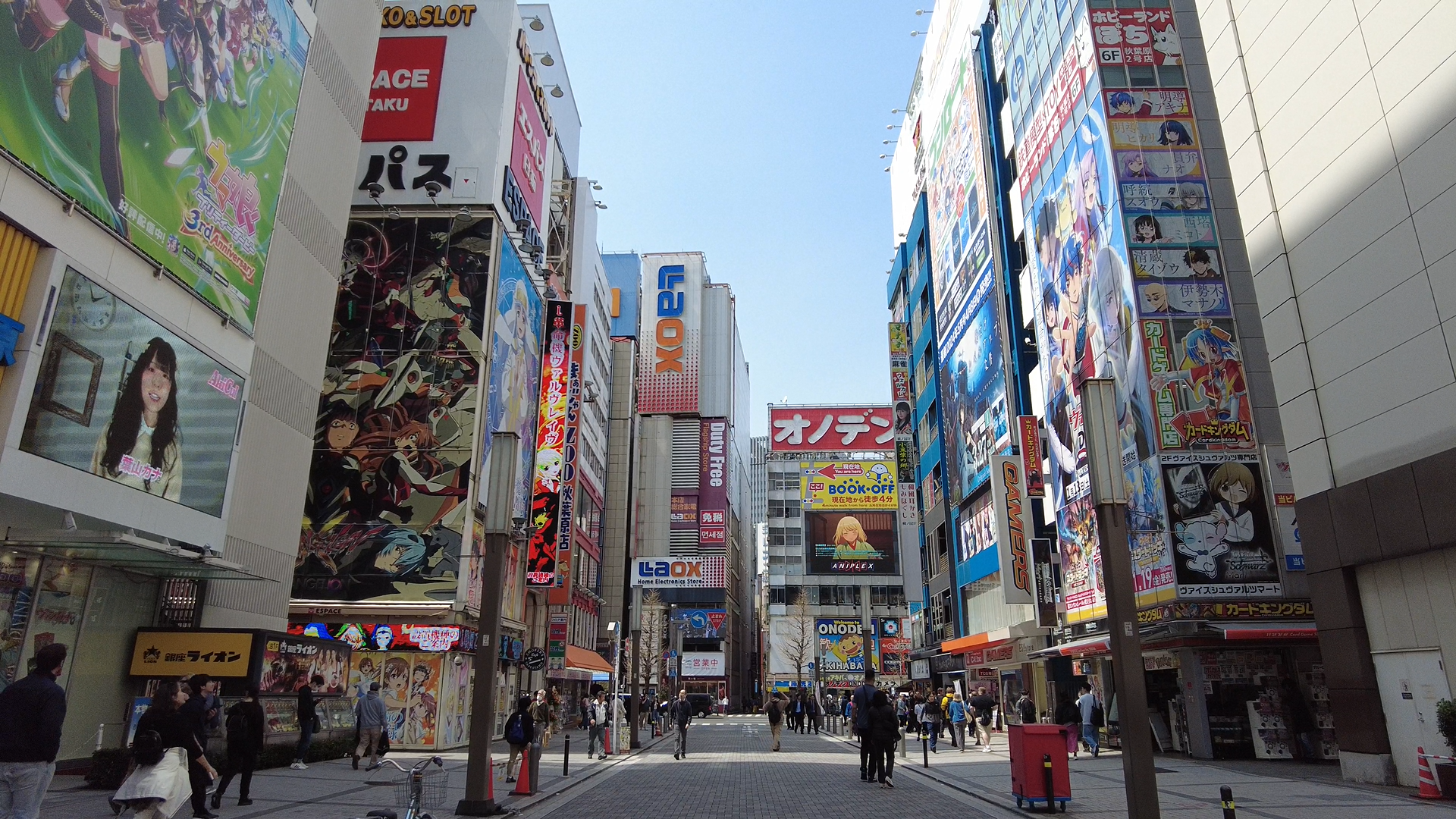
"Density does the work here: the interesting floors are rarely the ground ones."
Your experience

What a tour day looks like

A step-by-step walkthrough of the visit — what you'll see, how long each stage takes, and the details that matter.

You come out at the Electric Town exit and the noise arrives before the view: crossing chimes, a rhythm game's bassline, a recruiter's loop from a café doorway. Your guide waits by the ticket gates, and the first stop sits thirty metres away — a stall under the viaduct where capacitors wait in bins labelled only by number. Then you climb. Floors two through six of a single tower, each a different trade: trading cards sorted by rarity, 1/7-scale figures under glass, a basement where secondhand manga runs a few hundred yen a volume. You turn a Famicom cartridge over, blow dust off the connector, learn how the grading stickers work. Somewhere around the fourth building you stop counting staircases. Mid-afternoon you break at a themed café, order the set, and read the choreography of it without needing the language. Arriving inside the 10:00–18:00 window means the arcades are fully staffed and the upper floors are open. Outside, a go-kart convoy in costume swings off Chūō-dōri and three strangers film it. You finish at Kanda Myōjin, eight minutes uphill, where the ema boards carry character drawings and requests for clean code. Your Akihabara Walking Tour tour ends there, bag heavier than planned, with a mental index of which doorway hid which floor.

Frequently asked

Frequently asked questions about akihabara walking tour tours

What are the opening hours for an akihabara walking tour?

The district is open 00:00–23:59. Most retail shops are fully operational between 10:00–18:00.

Is there a fee for an akihabara walking tour?

Access to the district is 0 JPY. Public walking is free for all visitors.

When is the best time for akihabara walking tour tickets?

The best arrival window is 10:00–18:00 to ensure all shops are open.

Are there age restrictions for this akihabara walking tour?

There are no formal age restrictions for exploring the district.

Can I take photos during the akihabara walking tour?

Yes, photography is allowed in public streets during your akihabara walking tour.

Is the area accessible for wheelchairs?

Yes, the district is flat, though some individual shops may have steps.

Where should I start my akihabara walking tour?

Start your visit at the Electric Town Gate of Akihabara Station.

Are there restrooms available?

Public restrooms are available inside the station and in large shopping complexes.

What happens if it rains during the tour?

Many arcades and shopping malls provide shelter during your akihabara walking tour.